


A high-quality finish is about much more than appearance.
In industrial painting, poor finish quality can lead to rejected parts, rework, increased paint consumption, longer production times and higher overall costs. Even small variations in the application process can have a significant impact on the final result.
So, what causes poor finish quality in industrial painting?
The answer is rarely one single factor.
Spray pressure, atomisation, paint viscosity, material flow, gun setup, spray distance and the overall stability of the application process all work together.
Understanding these factors is the first step towards achieving a more consistent, efficient and repeatable painting process.
1. Incorrect spray pressure
Spray pressure has a major influence on atomisation and finish quality.
If the pressure is too low, the coating material may not atomise properly. This can result in larger droplets, uneven coverage and a coarse or inconsistent surface.
Increasing the pressure may improve atomisation – but more pressure is not always better.
Excessive pressure can increase overspray, paint consumption and energy use while potentially creating unnecessary turbulence around the workpiece.
The objective should therefore not be maximum pressure.
It should be the correct and stable pressure for the material, spray technology and application. Read more about Paint pressure regulators
2. Poor atomisation
Atomisation is the process of breaking the coating material into droplets before it reaches the surface.
The quality and consistency of these droplets have a direct effect on the final finish.
Poor atomisation can result in:
- Uneven surface texture
- Poor coverage
- Orange peel
- Inconsistent film thickness
- Increased material consumption
- Excessive overspray
The required atomisation depends on several factors, including the coating material, viscosity, pressure, nozzle configuration and spray technology.
Low Pressure, Airless and Air Assist systems achieve atomisation in different ways, which means that the correct setup depends on the specific application.
3. Incorrect paint viscosity
Paint viscosity is another important factor.
If the material is too viscous for the selected spray parameters, it may be difficult to atomise correctly. If the viscosity is too low, other problems with coverage and film build may occur.
Temperature can also influence viscosity.
This means that a process that performs well under one set of production conditions may behave differently if the material temperature changes.
For stable production, viscosity should therefore be considered together with pressure, flow and atomisation rather than as an isolated parameter.
4. Unstable material pressure and flow
Consistency is critical in automated industrial painting.
Even if the average pressure appears correct, variations in material pressure or flow can affect the spray pattern and the amount of coating applied to the workpiece.
This can result in variations in film thickness and finish quality between components.
A stable paint supply system, correctly selected pressure regulators and appropriate fluid handling equipment can therefore be just as important as the spray gun itself.
The spray gun can only perform consistently if the material reaching it is supplied consistently.
5. Incorrect spray gun distance
The distance between the spray gun and the workpiece affects how the coating reaches the surface.
If the gun is positioned too close, the coating may become too concentrated in a small area.
If it is positioned too far away, more material may be lost before reaching the surface, potentially increasing overspray and creating an uneven finish.
Maintaining the correct and repeatable distance is particularly important in robotic and automated painting systems.
Small positioning differences repeated across thousands of components can have a significant effect on both quality and paint consumption.
6. Incorrect spray angle
The angle of the spray gun also matters.
Ideally, the spray pattern should be correctly aligned with the surface being coated.
Complex geometries, corners, recessed areas and changing component shapes can make this more difficult.
Incorrect spray angles may result in uneven coating thickness, poor coverage and unnecessary overspray.
This is one reason why the complete application needs to be considered when optimising an automated painting process.
7. Worn or incorrectly selected spray components
Nozzles, air caps and other spray components are exposed to continuous wear.
Over time, this can affect the spray pattern, material flow and atomisation.
A process may therefore gradually become less efficient without an obvious single failure.
Regular inspection and maintenance of spray equipment is important for maintaining repeatable performance.
However, component selection is equally important.
A perfectly functioning nozzle can still produce poor results if it is not suitable for the material, required flow rate or application.
8. Too much paint
One common reaction to poor coverage is simply to apply more coating.
But more paint does not necessarily mean better quality.
Excessive material application can create runs, sagging, uneven film thickness and longer drying or curing times.
It also increases paint consumption and production costs.
The objective should instead be to apply the correct amount of material in the correct place with the required atomisation and film thickness.
This is where process optimisation can make a significant difference.
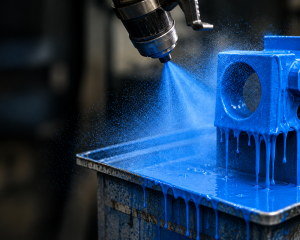
9. The wrong spray technology for the application
Different applications require different spray technologies.
Low Pressure
Low Pressure spray technology can provide excellent control and finish quality in applications where precise atomisation and spray pattern control are important. Our products for Low Pressure
Airless
Airless technology is often suitable where higher material flow and production capacity are required. Find out more about Airless sprayguns
Air Assist
Air Assist combines hydraulic atomisation with additional air control and can provide a balance between production capacity, transfer efficiency and finish quality.
There is no single technology that is best for every industrial painting process.
The correct choice depends on factors such as material, production speed, component geometry, required finish and desired transfer efficiency. Find out more about Air Assist sprayguns
10. The problem may not be the spray gun
When finish quality begins to deteriorate, the spray gun is often one of the first components to be investigated.
Sometimes that is where the problem is found.
But often it is not.
The cause may be somewhere else in the process:
- Unstable pressure
- Incorrect material flow
- Changing viscosity
- Incorrect gun distance
- Worn components
- Poor spray pattern
- Robot positioning
- Paint supply problems
- Incorrect process parameters
This is why replacing a spray gun without understanding the underlying cause may not solve the problem.
Look at the complete application process
Achieving consistent finish quality requires more than choosing the right spray gun.
The complete system needs to work together.
At Crescocito, we combine spray technology, fluid handling, engineering and application knowledge to evaluate the complete painting process.
By understanding how material pressure, flow, atomisation, spray technology and application parameters interact, it becomes possible to identify where improvements can be made.
The result can be:
- More consistent finish quality
- Reduced paint consumption
- Less overspray
- Fewer rejected components
- Less rework
- More stable production
- Improved process efficiency
Test before changing your production process
When several parameters interact, it can be difficult to predict the result by looking at specifications alone.
Testing provides a better answer.
In the Crescocito Test Lab, spray equipment, materials and application parameters can be evaluated under controlled conditions before changes are introduced into production.
Different pressures, flow rates, spray technologies and equipment configurations can be compared to identify a setup that provides the required finish while maintaining an efficient process.
Instead of asking:
“Which spray gun should we buy?”
a better question may be:
“How can we optimise the complete painting process?”
That is where application knowledge makes the difference.
Improve your industrial painting process
Poor finish quality is often a symptom rather than the actual problem.
Finding the cause requires understanding how the complete application system works together.
If you are experiencing inconsistent finish quality, excessive paint consumption, overspray or other problems in your industrial painting process, Crescocito can help you evaluate the application and identify opportunities for improvement.
Better finish. Less waste. More stable production.
Contact Crescocito to discuss your application or arrange testing in our Test Lab.


